Understanding Factors that Shape Children’s Long Term Engagement with an In-Home Learning Companion Robot


My research goal is to design, build, and evaluate technology-facilitated learning environments. My work brings together learning sciences, human–computer interaction, computing education, and social robotics.
I completed my Ph.D. in Learning Sciences at the University of Illinois Chicago in May 2026, advised by Dr. Joseph E. Michaelis. I also hold a master’s degree in Computer and Information Science from the University of Pennsylvania and a Bachelor of Science in Computer Science from Lahore University of Management Sciences.
My dissertation, “Broadening Participation of Girls in Computing: An Integrated Approach to Supporting Interest in CS,” examined how technological and social scaffolds support girls’ interest in computing. Through the MyTurn project, I designed a web-based pre-coding tool and studied its use alongside peer collaboration and mentorship during social robotics activities.
My broader research includes in-home robot learning companions and teacher-facing tools for designing robot-assisted learning experiences. I use iterative design and mixed methods to understand learners’ experiences and inform technology design.
My future research vision builds on my previous work to investigate the design of AI-enabled technologies that can adapt to learners’ evolving needs and complement social scaffolds embedded within authentic learning contexts to support learning and interest.
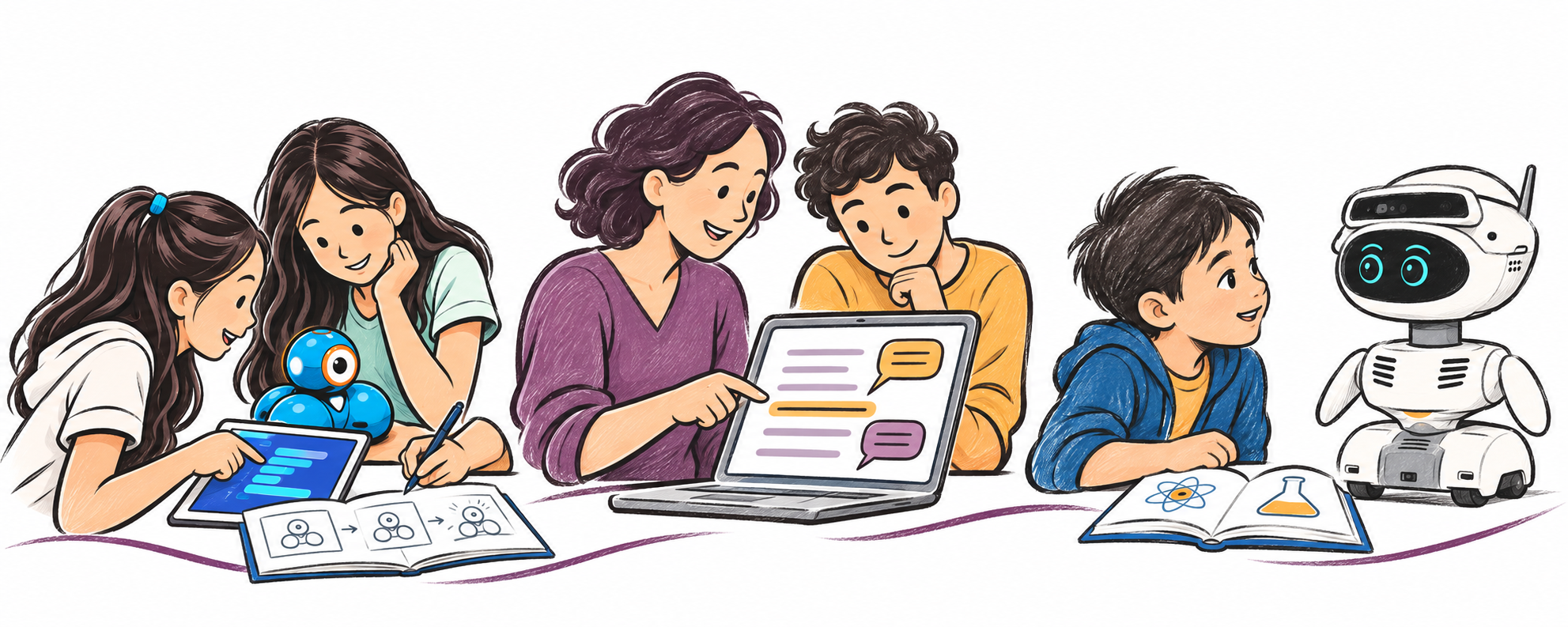
AI-generated illustration representing my research.